
Application
Railway information room power cabinets
Two utility feeds into the dual-source cabinet, and from there two branches: stabilizer and UPS. Both cabinets carry a maintenance bypass switch, so the whole arrangement is built around one requirement — the room does not go dark, not for a transfer and not for a service visit.
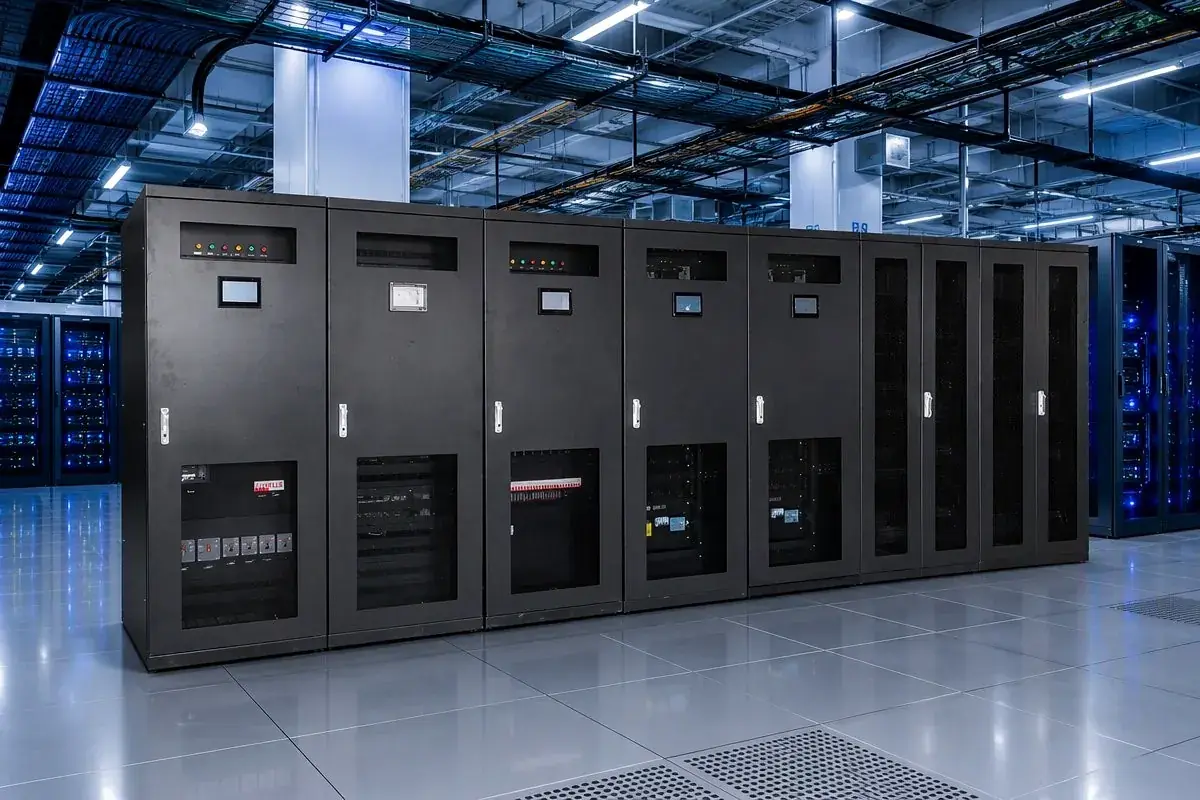
Two branches, each with a bypass
Two independent feeds enter the dual-source cabinet, one running and one on standby. Its outgoing side splits into two branches. The first goes to the stabilizer cabinet, where a ZBW-S static contactless unit holds the voltage inside the window and can transfer to mains bypass without interrupting the output; the stabilized supply then leaves through the stabilizer distribution cabinet to the loads that do not need autonomy — air handling, lighting, power sockets, non-critical equipment. The second branch feeds the UPS cabinet, whose battery string carries servers, network and signalling equipment across an outage and transfers between inverter and mains without a break; the UPS distribution cabinet splits that output across the rack rows. The battery cabinet then sets how long the room can run once both feeds are gone.
Both the stabilizer cabinet and the UPS cabinet carry their own maintenance bypass switch. To service either one, its loads are transferred to the bypass first and fed straight from the incoming supply, the cabinet is isolated, and only then is it opened — the room stays energised throughout, and it stays energised even when the feed itself is being swapped. Cabinets come in two footprints, 600 x 1000 x 2000 mm for single-column distribution and battery strings, and 800 x 1000 x 2000 mm where the breakers, the UPS module or the cable entry need the extra width. Both share the same 1000 mm depth and 2000 mm height so a row lines up and the front-to-back airflow of the room is not broken.
What to settle before ordering
- Which loads need autonomy and which do not — the split between the two branches decides the UPS capacity against the stabilized distribution capacity.
- Maintenance bypass on both cabinets, sized to carry the full load: without it a service visit means an outage, which defeats the point of the row.
- Keeping anything that can restart off the UPS branch: every kVA put behind the UPS is battery capacity taken away from the servers, and those loads never needed it.
- Backup time in minutes at the expected load, which fixes the number of battery cabinets and whether they are 600 or 800 wide.
- Whether transfer between the two feeds must be break-free, or a short mechanical break is acceptable for the loads behind it.
- The room layout: cable tray height, floor grille position and the width of each row, so the cabinet row is agreed before the concrete is drilled.
Two mistakes we see
- Running the air handling, lighting or power sockets off the UPS branch. The battery is sized for the servers; every non-critical kVA behind it shortens the runtime the room was designed around, for loads a short restart would not have hurt.
- Using a break-before-make mechanical transfer and calling the room redundant: the room still drops for tens of milliseconds on every transfer, and a server that reboots is not protected by a second feed.
Frequently asked questions
Why does one room need six cabinets instead of one integrated panel?
Because each function has a different service life and a different failure mode. Incoming transfer, regulation, distribution, UPS and battery are separated so any one of them can be worked on while the rest of the room stays live.
What happens to the load when the stabilizer or the UPS is serviced?
Both cabinets are fitted with a maintenance bypass switch. The load is transferred to the bypass and runs from the incoming supply while the cabinet is isolated and opened, so nothing has to be shut down. The bypass has to be rated for the full load, and the transfer sequence belongs in the room operating procedure.
Is the stabilizer cabinet optional if the room already has a UPS?
They sit on different branches, so neither one covers the other. The stabilizer branch serves loads that may restart; the servers are regulated by the UPS inverter itself. What still matters is the UPS input window — where the incoming feed swings outside it, the battery is called on at every sag.
What is the difference between the dual-source cabinet and the UPS?
The dual-source cabinet chooses between two live grid feeds, one main and one standby, and then splits the supply into the stabilizer branch and the UPS branch. The UPS supplies its own branch when neither feed is present. Transfer first, storage second.
How do we choose between the 600 and 800 mm cabinet?
By the number of outgoing breakers and the cable entry. Single-column distribution and battery strings fit 600 x 1000 x 2000 mm; where breakers are doubled up or the UPS module needs the width, the 800 x 1000 x 2000 mm cabinet is used. Depth and height stay the same either way.