
Isolation Transformer 380 to 220: When It Pays
The voltage is already there
A 220V control circuit arrives on a 380V four-wire supply. Phase to neutral measures 219V, so why add a transformer? A month later the feeder trips its residual-current device whenever a drive starts. Both readings are right, neither is a specification: the transformer does one of three jobs.
Three jobs that look like one
Voltage conversion. On four-wire systems the neutral is already the 220V source: 380 divided by the square root of three is 219V. No transformer is needed while a neutral exists and is healthy; it is needed when there is none, on three-wire 380V delta or a 220V machine where only three wires arrive.
Galvanic separation. The windings share a magnetic circuit and nothing else, so the secondary can have its own neutral and earth reference. A neutral, though, is a conductor with resistance.
Noise decoupling. Conductor-to-earth interference must cross the inter-winding capacitance, which is small; noise between line and neutral passes straight through. That gap explains most disappointments.
The three numbers that decide it
Measure phase-to-neutral voltage, neutral-to-earth voltage and neutral current under load; the middle one is often skipped. At 30A through 0.5 ohm of neutral path, the neutral sits 15V above earth and every reference tied to it moves too. Under 2V is unremarkable; above 10V, repair the neutral first.
Capacity comes from the load. A 220V load drawing 9A is 1.98kVA, exactly the rating of the largest ODK bench unit, so it runs at 100 percent; at 80 percent duty about 7.2A is usable, and a 10kVA unit gives about 45A at 220V.
Two more figures matter. The no-load secondary is set a few percent above nominal so full load lands on 220V. And energising a dry-type unit at an unlucky point on the wave can pull a first-cycle peak of eight to twelve times rated current, enough to trip a breaker sized on thermal current.
What to install
For a 220V circuit that only needs separation, the ODK single-phase isolation transformer covers 300VA to 2000VA in a bench-top case with sockets, Class F insulation, insulation resistance above 2 megohm and a 2500V withstand test.
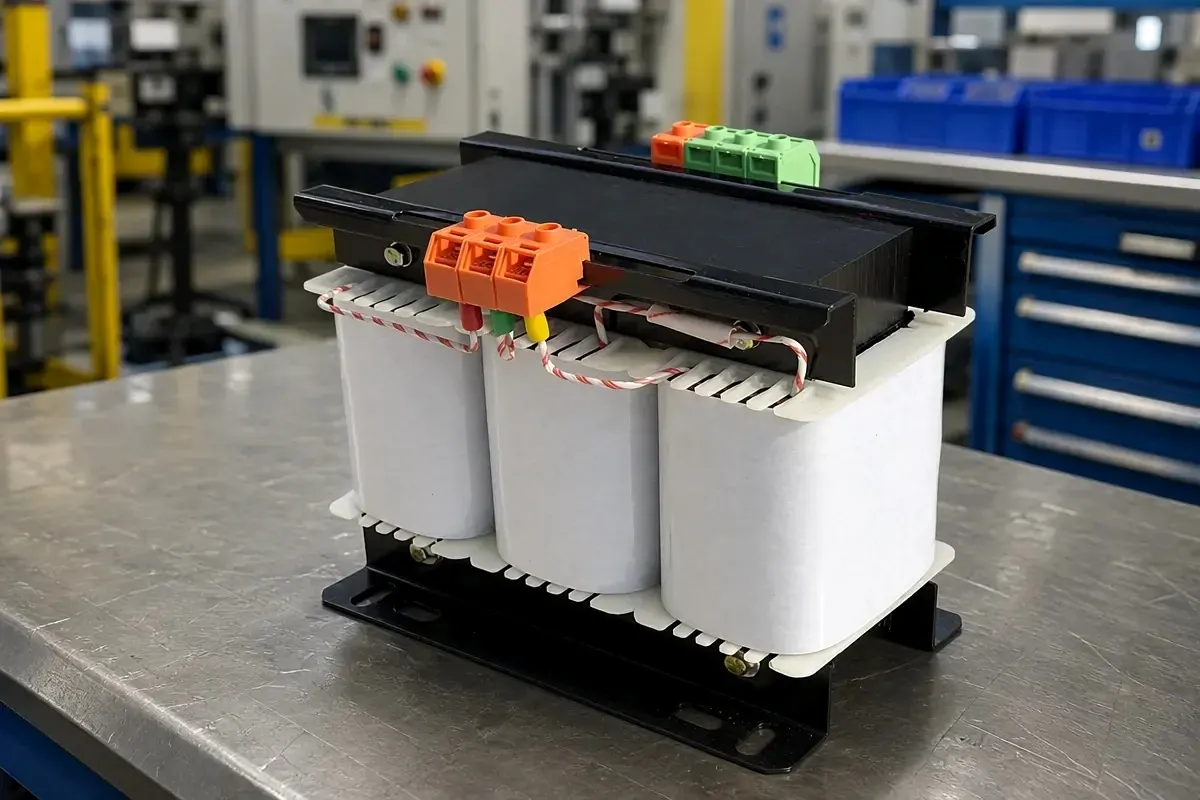
For 380V to 220V the three-phase route is the SG dry-type isolation transformer: air-cooled, Y/Delta connection combination, 500VA to 100kVA, efficiency of 99 percent or better, 1.2 times overload. Input is 380/660/440/220V, output 220/110V, both customizable; whether the 220V side runs line to line or as one line plus the secondary neutral is fixed at order. Control cabinets are the common case, see power for CNC machining centres.
An autotransformer such as the OSG series is worth naming only to rule out: one winding, cheaper for the same kVA, but primary and secondary stay continuous.
Where the answer stops being true
A fixed ratio does not regulate. If phase-to-neutral wanders between 195V and 245V the secondary wanders by the same proportion, so fitting one to cure flickering lights disappoints within a week. That is a stabilizer job, sized as in sizing from nameplate data.
Separation also relocates problems. High neutral-to-earth voltage at the main panel has an upstream cause, a loose neutral, an overloaded PEN conductor or unbalanced loading, and the transformer only gives the load a new reference, as three-phase faults a single-phase stabilizer cannot fix explains.
Protection needs reconsidering too: an isolating winding interrupts the fault path an upstream residual-current device watches, so the secondary needs its own. Harmonics pass through, and a delta winding gives triplen currents a path without removing them. A 220V load must never bridge two phases of 380V.
The short version
Where a solid neutral gives 219V and sits close to earth, install nothing and repair the wiring. Where 220V exists but the reference is noisy, a single-phase unit of 300VA to 2kVA separates the two sides cheaply. Where the supply is 380V without a usable neutral, a three-phase unit of 500VA to 100kVA does both jobs. Where voltage moves, none of these is the answer: that is regulation, not isolation. Send the measurements and the load list.
" · T · e · c · h · n · o · l · o · g · y · · S · e · l · e · c · t · i · o · n · "