Grid at 40V: What a Home Stabilizer Can and Cannot Fix
What 40V actually is
Forty volts on a nominal 220V supply is 18 percent of nominal, and loads respond to that in two very different ways. A 2kW heater rated at 220V delivers about 66W at 40V, because power falls with the square of voltage: it is not damaged, it simply stops doing its job. A motor is worse. Torque also falls with the square of voltage, so at 18 percent of nominal an ordinary induction motor has roughly 3 percent of its rated torque - it cannot accelerate at all, sits at locked-rotor current, and either trips its overload or burns out. This is why weak-grid complaints almost never arrive as "the appliance runs slowly". They arrive as "it trips constantly".
Inside the window and outside it
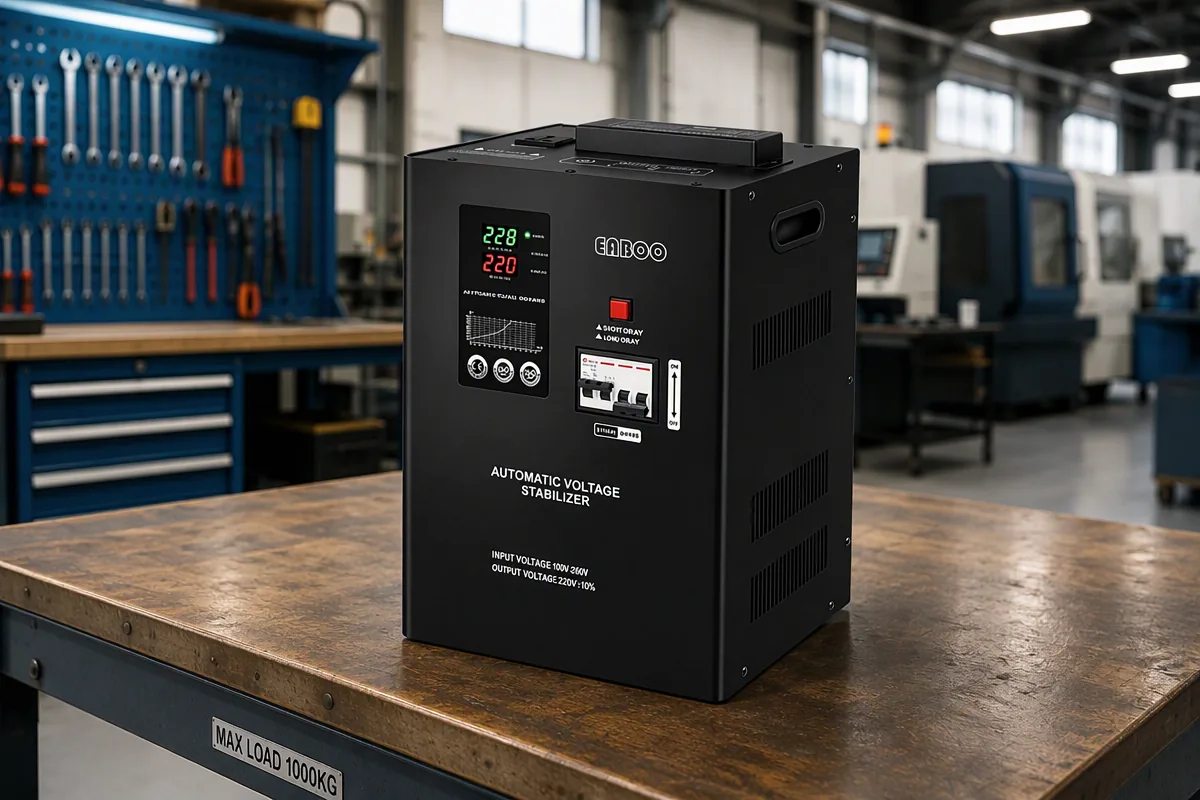
Every stabilizer has an input window, and the window's lower edge is a design choice rather than a law of physics. Above that edge the unit boosts or bucks continuously and holds its rated output; below it the controller cannot produce enough correction and goes to protection or to bypass. Our standard relay windows are AC 100-260V for the TM series and the BTM cabinet, AC 80-260V for the WTM wide-input series, and the standard servo windows are AC 150-250V. A feeder at 40V is outside all four, so the first honest answer to "will a home stabilizer fix my 40V supply" is that the standard models will not even try.
What a stabilizer can fix
Within its window, a stabilizer does three useful things. It holds the output at 220V while the input sits anywhere from 80V to 260V, which on a long rural feeder is the difference between a refrigerator that runs and one that chatters. It absorbs the short sags caused by a neighbour's welder or a pump starting on the same phase. And it keeps the output inside a stated band - plus or minus 8 to 10 percent for a relay unit, so 198V to 242V, or plus or minus 3 percent for a servo unit, so 213V to 227V. Those are the real numbers behind the word "stable", and for household equipment they are enough: a fridge, a television or a phone charger does not care whether it sees 198V or 242V.
What a stabilizer cannot fix
A stabilizer cannot fix a voltage drop that the load itself creates. This is the part that catches buyers out. The drop across a feeder is the load current multiplied by the line impedance, so a site that measures 140V with nothing switched on and 40V under load is telling you that 100V is being lost inside its own line. A boost-type stabilizer restores the voltage at the load terminals by drawing more current from the line - and more current makes that same line drop larger. Push hard and the unit ends up hunting between boost and protection. That is a wiring and transformer problem, and no stabilizer brands its way out of it.
It also cannot fix frequency, a missing phase, a drifting neutral on a four-wire system, harmonic distortion or a three-phase imbalance; those need different equipment, as three-phase faults explains. And it cannot make a motor that is physically too large for its feeder start, because the start-up current collapses the line before the stabilizer has anything to work with.
Why the drop matters more than the level
Measure twice before choosing anything: at the socket with the load disconnected, and again with the load running. The gap between the two readings is the part of the problem that belongs to the site, not to the grid. A 20V gap on a 220V feeder is normal; a 100V gap is a site that needs a shorter or thicker service conductor, or a transformer closer to the load, before any electronics will help. Buying a bigger stabilizer to fight a load-induced collapse is the most common way to waste money on a weak grid.
What worked on the Tajikistan site
The site that produced the 40V reading is documented in the Tajikistan case study. What solved it was not a bigger standard unit but a custom wide-input design: an input window of AC 45-260V, zero-cross switching so that tap changes do not add their own transient, and a soft start that ramps the load instead of demanding full current on the first cycle. The soft start is the part that matters most at 40V, because it is the inrush that drives the collapse in the first place. Keep the load current low for the first second and the line recovers enough for the stabilizer to work with.
How to measure before you specify
Log the voltage at the socket the appliance actually uses for a week, not at the panel, and note the time of day and which appliances were running. Report the worst 30 minutes rather than the single worst instant: a stabilizer has to survive the worst half hour, and one deep dip from a one-off event should not drive the whole specification. Send us the no-load reading, the loaded reading, the load list and the capacity you need, and the window can be quoted against real numbers instead of a guess. If the units are going out under your own brand, the same four figures decide the input window, and OEM production covers the panel language, socket standard and carton around it.
Weak grid · Selection