Wide Input vs Standard Relay Stabilizer: 80V or 100V?
What sets the cut-off
A relay stabilizer corrects by switching transformer taps, so its lowest tap is also its lowest input voltage. Below that point the controller has run out of taps: it cannot boost any further, and the unit goes to protection or bypass rather than pretending to regulate. The cut-off is therefore a design decision with a price attached, because a lower floor means more taps, a bigger transformer and a heavier cabinet. The two single-phase relay ladders we build sit 20V apart for exactly that reason.
Two ladders, twenty volts apart
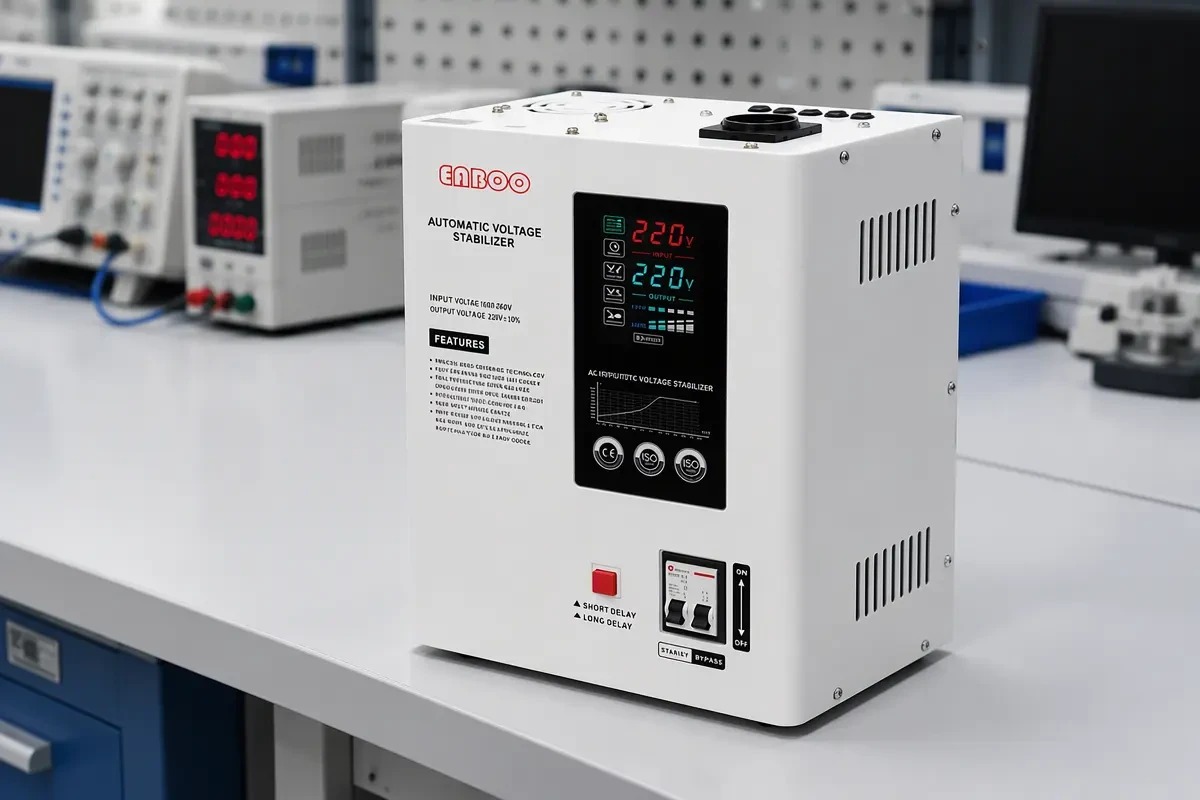
The TM relay-type stabilizer is specified at AC 100-260V, from 500VA to 5KVA, with plus or minus 8 or 10 percent accuracy. The WTM wide-input series is specified at AC 80-260V, from 1KVA to 10KVA, at the same accuracy, and adds multi-standard sockets - universal, UK, European, Indian R6 and US - because it was designed for export markets where the supply and the plug both vary. The BTM cabinet keeps the 100-260V window and the same accuracy in a vertical cabinet with input-current and fault-record readout. All of them are 50/60Hz and all can be built to a wider custom window, up to 45-280V.
What the extra 20V buys
It buys the evening. A feeder that measures 235V at noon and sags to 90V between seven and ten in the evening is outside the TM window for the hours when the household actually uses power; a TM on that feeder will spend the evening in protection, and the customer will report a broken stabilizer rather than a broken grid. On the same feeder the WTM still regulates, because 90V is inside 80-260V. That is the whole case for the wider window: it is not about the average voltage, it is about the voltage during the hours that matter. The same logic applies to a 95V site, a 105V site, and any feeder whose evening value sits between 80V and 100V.
What the wider window costs
The low tap is a bigger winding and more switching hardware, and at the bottom of the window the unit runs at its highest input current for a given output, which is its hardest thermal condition. That is why a wide-input relay unit is not the cheapest item in the line, why it is heavier for the same kVA, and why it is worth specifying only when the measured floor actually demands it. If a site never drops below 110V, the WTM's extra window is paid for and never used; a TM does the same job for less.
When 80V is still not enough
Two situations take you past both ladders. The first is a measured floor below 80V - some rural feeders sit at 70V for hours, and no standard tap set reaches that. The second, and the more common one, is a load-induced collapse: the site reads 140V with nothing running and 40V under load, so the line is losing 100V inside itself and the stabilizer has to work at an input voltage that would trip any standard unit. That case is documented in the Tajikistan case study and analysed step by step in what a stabilizer can and cannot fix at 40V. Both are specified as custom builds at AC 45-260V or 45-280V, with soft start so that the load does not re-create the collapse every time it restarts.
How to find the floor your site needs
Do not size on the worst reading you have ever seen. Log the socket voltage for a week, then take the worst half hour that repeats - the value the site reaches most evenings - and specify against that. A single 60V spike caused by a one-off event will push you into a custom build you do not need, while an average of 200V will hide the 90V evenings that actually break appliances. If you have a logger at the panel and the socket, use the socket reading: the drop between the two is the part of the problem that belongs to the building's own wiring. Report both the no-load and the loaded values, because the difference between them is what tells us whether a wider window is the answer or whether the service conductor is.
Choosing between the ladders
A measured floor of 100V or above points to the TM ladder, which covers 500VA to 5KVA and is the simplest, most proven unit we build. A floor between 80V and 100V on an evening feeder points to the WTM ladder at 1KVA to 10KVA, with the socket standards that export markets ask for. A floor below 80V, or a site whose loaded voltage collapses well below its no-load voltage, points to a custom wide-input build. If the install needs a cabinet and a visible fault record, the BTM covers 1KVA to 10KVA at the 100-260V window; if the load is a whole building rather than a household, the answer moves to three-phase regulation. For importers buying by the container, the window, the sockets and the panel language are configured together on the OEM page.
Relay · Selection